
System Requirements
The computer running Hexcast must meet the plug-in requirements below. Playback devices require a supported browser and network access to that computer.
-
macOS Catalina 10.15 or later on Intel; macOS Big Sur 11 or later on Apple silicon.
-
Apple silicon or Intel x86-64 processor.
-
Minimum of 2 GB RAM.
-
Graphics hardware and compatible drivers supporting OpenGL 3.3 or later. Integrated graphics are supported; a dedicated graphics card is not required.
-
The DAW computer and playback devices must be able to communicate on the same IPv4 local network. Firewalls and Wi-Fi client isolation must allow access to Hexcast’s configured server ports.
-
An internet connection and a Hexmark Records account are required to obtain and activate an evaluation or full licence.
-
A compatible 64-bit DAW supporting VST3 or Audio Units (AU).
-
For AAX: a compatible 64-bit version of Pro Tools.
-
64-bit Windows 8.1 or later (x64).
-
Intel or AMD x86-64 processor with AVX support.
-
Minimum of 2 GB RAM.
-
Graphics hardware and compatible drivers supporting OpenGL 3.3 or later. Integrated graphics are supported; a dedicated graphics card is not required.
-
The DAW computer and playback devices must be able to communicate on the same IPv4 local network. Firewalls and Wi-Fi client isolation must allow access to Hexcast’s configured server ports.
-
An internet connection and a Hexmark Records account are required to obtain and activate an evaluation or full licence.
-
A compatible 64-bit DAW supporting VST3.
-
For older Windows VST3 hosts, select the Legacy VST3 installation option; see Installation.
-
For AAX: a compatible 64-bit version of Pro Tools.
Ethernet is recommended for the DAW computer, with reliable Wi-Fi or Ethernet for playback devices.
-
Chrome / Chromium
-
Firefox
-
Safari
-
Microsoft Edge
-
Brave
-
Opera
HTTPS is recommended for lower-latency playback. HTTP uses a compatibility playback path.
Overview
Thank you for choosing Hexcast.
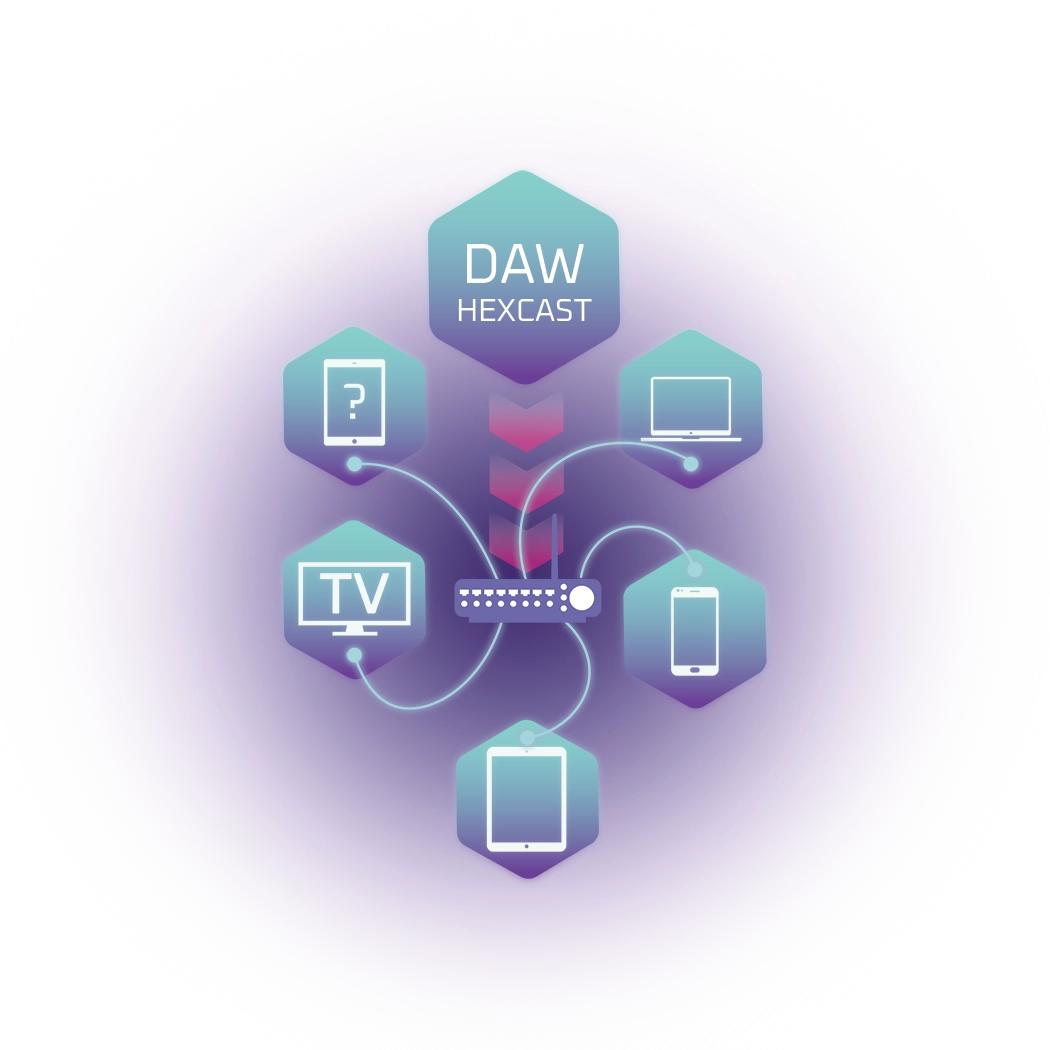
Hexcast is an innovative addition to any audio professional’s toolkit. It is designed for those who strive to achieve mixes that translate across various playback systems. The concept is simple. Hexcast gives you the ability to seamlessly stream your current session in real time from your Digital Audio Workstation (DAW) to any device with a modern web browser on your Local Area Network (LAN).
For decades, audio engineers have tested their final mixes on various systems inside and outside of the studio; resulting in the variation of physical size, wattage and frequency response. The sole reason for this is to ensure the audio is balanced across platforms that a typical user would consume the media through. Not all users have high quality speakers with both a wide frequency response and crystal-clear signal chain. Often consumers of audio will listen to audio via earbuds, phone speakers, laptops and TVs; all of which are suboptimal.
An audio engineer’s workflow would often bounce snippets of the final mix, transfer it to cloud storage and download it to a phone for audition. This is often where issues arise. For example, high-hats sound shrill in the mix due to them being simply too loud. Returning to the studio, they would follow up with fine adjustments, repeating what can be a laborious process until a balanced mix is achieved.
The primary aim of Hexcast is to identify mix issues which can be rectified in real-time allowing you to directly stream your master bus directly to your phone, tablet, TV or Laptop. All with the click of button which saves you both time and disappointment. Furthermore, testing each mix decision across various devices in real time, ensures the accuracy of each change. This leads to a superior mix. Especially when compared to those who may not exercise high levels of due diligence.
In addition to having a mix application, Hexcast can be used for mastering audio too. A mastering engineer can carefully tailor their final brick wall limiter settings and test it on a phone to achieve that sweet spot we all crave between the studio monitors and suboptimal devices. Using Hexcast, a mastering engineer can seamlessly transition between their luxurious studio monitors and their phone, laptop, TV or tablet.
We know Hexcast will be a great weapon in your audio arsenal.
Activation
To evaluate or fully activate, Hexcast requires both an internet connection and a generated activation code obtained via the Hexmark Records website.
To evaluate follow the instructions below:
-
Navigate to https://hexmarkrecords.com/store/plugin/hexcast
-
Sign in to your account or Register.
-
To evaluate click Get Demo Licence. However, if you have signed up via the button on this page the system may automatically generate an Evaluation Licence for you.
-
Now you should see the download links for the respective platforms along with the activation code.
-
Copy the activation code as you will need to activate the product after install.
-
Next install the application using the instructions in the installation section.
To activate the full version after licence purchase, follow the instructions below:
-
Navigate to https://hexmarkrecords.com/store/plugin/hexcast
-
Sign in to your account or Register.
-
Add the licence to the cart, click checkout and complete the purchase.
-
Navigate to the My Account page (although the journey may automatically redirect you to the page). https://hexmarkrecords.com/account#licences
-
Copy the activation code. You will need to activate the product after install.
-
Finally, install the application using the instructions in the installation section. Note: If you move machines or significantly change the hardware, you will need to generate a new activation code due to the licence code being derived from your hardware.
Installation
Mac
-
Download the setup file for your platform.
-
Double-click the setup file hexcast-1.1.0.pkg.

-
The setup wizard will guide you through the installation.
-
The default installation includes VST3, Audio Units (AU), and AAX. Use Customise to select the formats you require.

-
The next screen permits you to change the location of the installed plugins if desired.

-
Click install and enter password if applicable.
-
Once the software has completed installation click close to finish.

Windows
-
Download the setup file for your platform.
-
Double-click the setup file hexcast-1.1.0.exe.

-
Use the setup wizard to guide you through the installation by clicking Next to continue.
-
Choose a desired location for the plugin Core and click Next/Install.

-
Select the plugin format(s) to install.

-
Before proceeding, you’ll be prompted to choose between two versions of the VST3 plugin format: Modern or Legacy.
-
Modern uses the VST3 bundle format, which includes embedded resources such as icons and metadata.
-
Legacy installs the plugin as a single
.vst3file for older 64-bit VST3 hosts, such as Cubase 11, that require this layout. It does not provide VST2 or 32-bit support.Select Modern unless you specifically need compatibility with an older DAW.

-
-
Choose a desired location for the VST3 plugin installation (if applicable) and click Next/Install.

-
Choose a desired location for the AAX plugin installation (if applicable) and click Next/Install.

-
Once the software has completed installation click close to finish.

Authorise and Activate
Now that the plugin has been installed, launch your DAW. It should be detected as a new plugin under the effects context menu. (Please consult your respective DAW manual for instructions pertaining to insert effects.)
-
Open a new instance of the plugin on your master-bus to launch the plugin GUI.
-
Initially, you will be presented with the Activation modal.
-
Enter your email used to create an account on https://hexmarkrecords.com along with the activation code described prior.
-
Once entered click Activate. This will retrieve the Licence from Hexmark Records’ servers to activate the plugin.

You can verify the activation status by opening the About modal within the plugin.
Technical Overview
Architecture
Hexcast comprises two distinct components. The plugin (VST3, Audio Units, or AAX) runs as an insert effect within your DAW and the Hexcast Web Client, the microsite web application that runs on the device required to monitor your master bus through.
Hexcast can support up to six simultaneous connected devices with varying sample rates and channel configurations. Each client can divert the audio from your main studio monitors to its own internal loudspeaker, enabling the monitoring of your mix in real-time to achieve a balanced mix across the devices.
In addition to managing multiple connections, Hexcast intelligently retrieves the client audio configuration. Such as sample rate and channel configuration. It uses this information to resample the stream on the fly to ensure the data is in the correct format for the client. For example, suppose your phone is configured to support a 48kHz sample rate and your DAW is set to 44.1 kHz, Hexcast will resample the stream in real-time to match your phone to ensure accurate playback.
Signal Path
As Hexcast has been designed for In The Box (ITB) usage it should be instantiated as the last plugin on your master bus. The reasoning for this is that it routes the audio through your studio monitors when a client device is not streaming and diverts the audio from your studio monitors when a client device stream is active.
The plugin supports both mono and stereo configurations only. Although most audio applications are stereo based. In the event that the client’s device only supports mono configuration, Hexcast will convert the audio to mono to conserve bandwidth.
Network Setup
Hexcast uses your IPv4 Local Area Network to transmit audio blocks to connected devices, forming a stream. The DAW computer and playback devices must be able to communicate with each other; firewalls and Wi-Fi client isolation must allow access to Hexcast’s configured server ports. Ethernet is recommended for the DAW computer. For Wi-Fi playback devices, use a reliable connection and prefer the 5 GHz or 6 GHz band, where available, to reduce interference from congested 2.4 GHz networks.
When you launch the plugin, you will see your local IP address in the LCD address bar on the main panel along with the default port for the Hexcast internal web server. This indicates that the plugin is ready to serve audio via its own internal web application. (More on that later.)
In the event that the plugin cannot connect to your network, you will be presented with the IP resolution. This indicates that the plugin is currently searching for network connectivity, and until the IP address is determined will render the plugin non-operational.
Using Hexcast
Hexcast has been designed with simplicity in mind. There are very few controls for the value that Hexcast offers. As stated above, instantiate the plugin at the end of the master bus chain and you will notice the plugin operates in pass through mode as there are no connected web clients.
|
Only one instance of Hexcast can be used on a system at any one time and with good reason. Hexcast binds to two ports exclusively thus another instance would result in a conflict with itself. See Troubleshooting Guide at the end of this manual for more detail. |
Main Interface

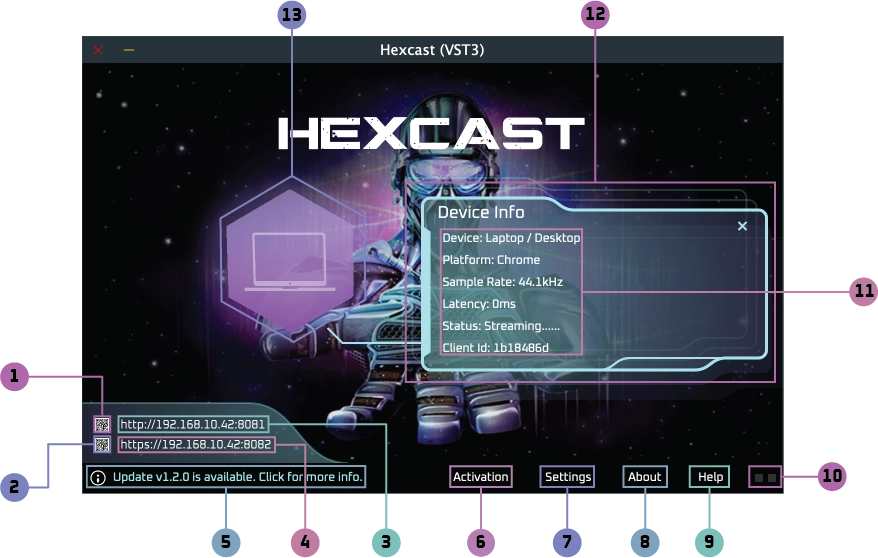
As you can see the main interface is quite simple. The UI is mostly presentational with options to manage the plugin configuration. As a web client device joins the session, a hexagon icon is displayed, gently rotating in a carousel in Mex’s hand.
Furthermore, the icon depicts the type of device connected to Hexcast, allowing you to differentiate between devices. Click the device icon to reveal further details about the connected devices. Such as sample rate, device type and the I.D. Clicking anywhere on the main panel will return the icon back to the rotating carousel.
Below details the UI controls along with their purpose:
-
QR Code (HTTP) - Click to open the QR Code modal for smartphone access to the Hexcast web client application.
-
QR Code (HTTPS) - Click to open the QR Code modal for smartphone access to the secure Hexcast web client application.
-
Hyperlink (HTTP) - Click to open the Hexcast web client application in the default browser.
-
Hyperlink (HTTPS) - Click to open the secure Hexcast web client application in the default browser.
-
Info message bar - Provides informative messages regarding events raised by the system, such as status messages, software updates or error messages. Additionally, it’s used to display help text when you mouse over actions within the UI window.
-
Activation button bar option - Launches the Activation modal. Please note that after a successful Full Licence Activation, the option is removed as it is no longer relevant post Activation.
-
Settings button bar option - Launches the Settings modal where you can change the web server preferences, lossless compression and manage analytics.
-
About button bar option - Displays the credits and licence information.
-
Help button bar option - Opens a summarised online manual using your default browser.
-
Audio activity indicator - Illuminates when an audio signal is supplied to the plugin. In the event that the signal is clipped, the LEDs colour will transition to red.
-
Device Details:
-
Device - describes the type of device connected to Hexcast.
-
Platform - the browser vendor information for the connected device.
-
Sample Rate - Web client device sample rate (not the host sample rate) in kHz.
-
Latency - Estimated one-way stream latency in milliseconds.
-
Status - Determines if the client is streaming or idle.
-
Client Id - Unique ID for the connected client device.
-
-
Device Info Callout - callout to provide the associated information to correspond with the connected device.
-
Device Icon - Depicts the type of connected device.
Web Client Device Interface
The web client application serves as the controller for the client device UI run in a browser. The interface adopts a simple design that is both clean and accessible. Keyboard accessibility is important to allow the use of a remote control when accessed on a TV or device without a mouse or touchscreen.
Hexcast offers two connection protocols, HTTP and HTTPS. We recommend that you use HTTPS where possible as it permits the Hexcast client web application to use a separate background process to process the audio rather than sharing the same process responsible for rendering the page. HTTP connections are supported as a fallback to maximise compatibility between Hexcast and client devices and should be used if HTTPS cannot be used.
The section below details the UI controls along with their purpose:

-
Client Status - This will reflect the current state of the plugin. It normally displays the current sample rate of the client device.
Note Initially, it reads "Ready!" Once the STREAM button is clicked, the Web Interface establishes the connection. -
Stream button - This button activates the stream and allows the audio to play through the client device. Notice how the audio no longer is played through your studio monitors. The button caption will change to STOP and when clicked will return the audio stream back to your studio monitors.
Ensure your studio monitor volume is set to a safe listening level before switching between streams. -
Sync button bar option - This button is enabled when the audio stream is active. Its sole purpose is to clear the buffer and realign the audio stream with the DAW in the event that a considerable latency is introduced.
-
Buffer Multiplier - This option increases the internal buffer size of the client. It is typically used with older hardware or in situations where audio dropouts occur frequently. The system attempts to automatically match the plugin’s buffer size to the client device; however, this option allows you to manually control the buffer size. If Auto is selected, the system will attempt to determine the optimal buffer size based on current network conditions.
Note that the buffer multiplier pertains to each client individually and will be restored even after closure. -
About button bar option - This option allows you to view detailed device information similar to what is displayed in the callout on the main screen. You can use this view to match the Client ID with the one shown on the main screen in order to identify a specific device. See Web Client Device Information for a description of the information shown.
-
Help button bar option - This option provides a convenient way to access to the Hexcast online manual.
-
Volume Control - Allows you to adjust the volume on the client device.
Note that the volume level pertains to each client individually and will be restored even after closure. -
Audio Activity Indicator - Illuminates when an audio signal is received by the web client. If the signal is clipped, the LED color will transition to red.
-
URL Address - Web address of the Hexcast Microsite.
|
Whilst the client device is streaming audio data the web application prevents the sleep operation on your audio device. This impacts battery life during usage and you may need to recharge your device after heavy usage. |
Web Client Device Information
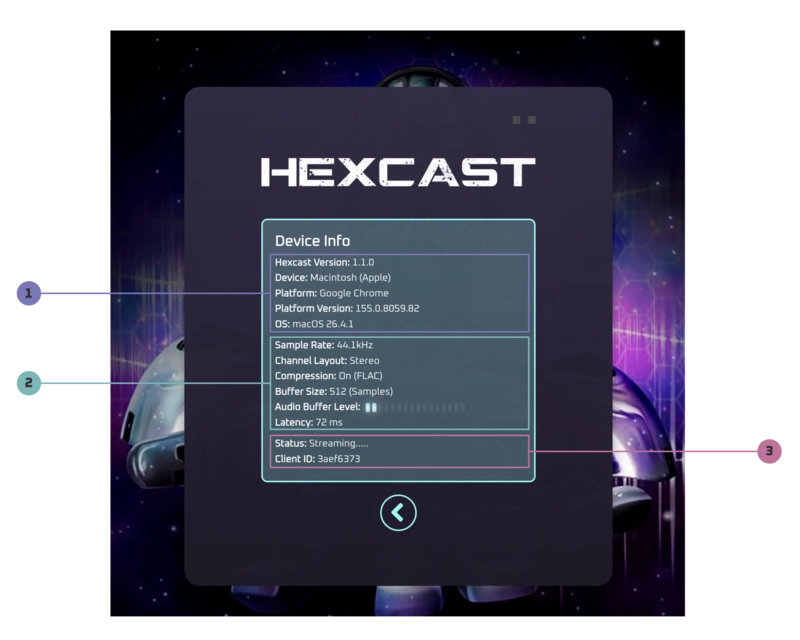
Click About on the web client’s button bar to open the Device Info view. This screen brings together information about the device, its audio configuration and the current stream. It is useful when checking a connection, comparing playback across devices or gathering details for troubleshooting.
The information is arranged into three sections, as shown below. These fields are for reference; they do not change the device or stream settings.
1. Platform
This section identifies the device and browser running the Hexcast web client. These details help you distinguish between connected devices and identify differences in their software environments.
-
Hexcast Version - The version of the Hexcast web client currently loaded in the browser.
-
Device - The detected device model or type, with manufacturer or operating system information where available.
-
Platform - The browser used to run the web client, such as Google Chrome or Safari.
-
Platform Version - The detected version of that browser.
-
OS - The device’s operating system and its reported version.
Device and software details depend on the information made available by the browser. Some fields may display Unknown when that information cannot be determined.
2. Audio state
This section shows the audio configuration used by the client, together with information about buffering and stream latency. Different devices may use different sample rates, channel layouts and buffer settings within the same Hexcast session.
-
Sample Rate - The sample rate used for audio playback on this client, shown in kHz. It may differ from the sample rate used by your DAW.
-
Channel Layout - The channel configuration negotiated for this client: Mono or Stereo.
-
Compression - Whether the stream uses lossless compression. On (FLAC) indicates compressed audio; Off (PCM) indicates uncompressed audio.
-
Buffer Size - The audio block size used for client processing, expressed in samples. This describes the processing block size; the amount of audio currently waiting to play is shown separately by the buffer meter.
-
Audio Buffer Level - Where available, the illuminated segments indicate the amount of playable audio queued on the client. The display can fluctuate as audio arrives and is played. It shows buffered audio, rather than signal loudness, and does not need to remain full during normal playback.
-
Latency - The estimated one-way stream delay, shown in milliseconds. A lower value indicates a shorter delay. Use this as a guide to stream responsiveness; the value does not establish the complete delay through the device’s speakers or headphones.
If playback becomes unreliable, the buffer level and latency can help you assess what is happening alongside what you hear. See Troubleshooting for guidance on buffering, connection problems and increased latency.
3. Stream status
This section identifies the client’s streaming state and provides a way to match it to the corresponding device in the plugin.
-
Status - Indicates whether streaming is active. Streaming means that the client’s stream is active; Idle means it is not currently streaming. An active stream does not by itself confirm that sound is audible, so also check the client’s volume and selected audio output if necessary.
-
Client ID - The identifier assigned to this client connection. Match it with the Client Id shown in the plugin’s device details to identify the correct device when several clients are connected.
Click the back arrow beneath the information panel to return to the main web client controls.
Connect a Web Client Device
Hexcast can support up to six simultaneous connected web client devices for a single session. A web client device is either a Smartphone, Laptop, Tablet or TV.
There are two methods to connect a device:
-
Click the QR Code for either HTTP or HTTPS access.
See Figure 3 : points (1) and (2) on the screenshot.
-
Use your phone’s camera to scan the QR code and you will notice a message to navigate to a local web address similar to https://192.168.1.102:8082.
-
Click the link on the message.
-
You will be presented with the Hexcast web client controller or a warning to resolve (see Browser HTTPS Warning section).
-
Click the STREAM button on your Smartphone, Laptop, Tablet or TV.
See Figure 4 : point (2) on the screenshot.
-
The audio will be diverted from your studio to your device.
-
By clicking STOP will return the routing back to the studio monitors.
See Figure 4 : point (2) on the screenshot.
-
Notice on the LCD Address bar the presence of a URL similar to https://192.168.1.102:8082
See Figure 3 points (3) and (4) on the screenshot.
-
Open up a web browser on your Phone, tablet etc
-
Enter the full web address into the browser (you may want to favourite it for next time)
See Figure 4 point (8) on the screenshot.
-
You will be presented with the Hexcast web client controller or a warning to resolve (see Browser HTTPS Warning section).
-
Click the STREAM button on your Smartphone, Laptop, Tablet or TV.
See Figure 4 point (2) on the screenshot.
-
The audio will be diverted from your studio to your device.
-
By clicking STOP will return the routing back to the studio monitors.
See Figure 4 point (2) on the screenshot.
Browser HTTPS Warning
As mentioned prior, Hexcast offers two protocols for when making a connection. Namely HTTP and HTTPS. We suggest using the HTTPS link as it allows the audio and data inflator to run in low-latency mode in a background thread. HTTPS is required to run the Hexcast web client in a secure context to access lower-level audio capabilities of the browser, resulting in lower latency, thus a better user experience.

On first use, using a browser on your Phone, Tablet, etc you will notice your connection is not private warning when accessing the link via HTTPS. Proceed by clicking through to Advance accept the risk. Hexcast generates a Self-signed Certificate to be used purely for LAN connections and does not serve audio data across the internet.
-
Click Advanced - To expand the option to proceed. In the event advance button is not visible type the following, "this is unsafe" to proceed.
-
Click Proceed to 192.xxx.xxx.xxx - To navigate to the Hexcast Microsite.
Settings
The setting modal screen allows you to configure Hexcast’s internal web server to serve the web app and audio stream. The majority of users will not find much use for this screen as it contains mainly advanced options to tune Hexcast functionality.
The section below details the options along with their purpose:

-
HTTP Port - Choose a unique alternative port to serve the HTTP based web application.
-
HTTPS Port - Choose a unique alternative port to serve the HTTPS based web application. Selecting an alternative port will result in the generation of a new Self-signed Certificate, which may result in the HTTPS warning reappearing.
Note: Certain ports cannot be assigned due to operating system restrictions. For a full list of those excluded see the Appendix. -
Export Certificate - This allows you to export the Self-signed Certificate in case you would like to install it onto another system to prevent the "Your connection is not private" warning. It exports the certificate in PEM format.
-
Lossless Compression - This option enables data compression involving producing approximate waveform whereby the differences are inaudible to the user. Hence lossless. This can potentially save up to 60% of bandwidth usage although it introduces a small delay in the signal path. Providing the client uses a modern browser, the Hexcast web client attempts to use an extremely fast, low-level, near-native performance decoder to inflate the data back to the original (or close) audio. It’s worth keeping this option enabled to save bandwidth. However, it is possible to disable compression, thus allowing raw PCM data to be transferred. Furthermore, this option can be disabled if you are experiencing FLAC decode errors or you wish to maximise an extremely fast connection for audio.
-
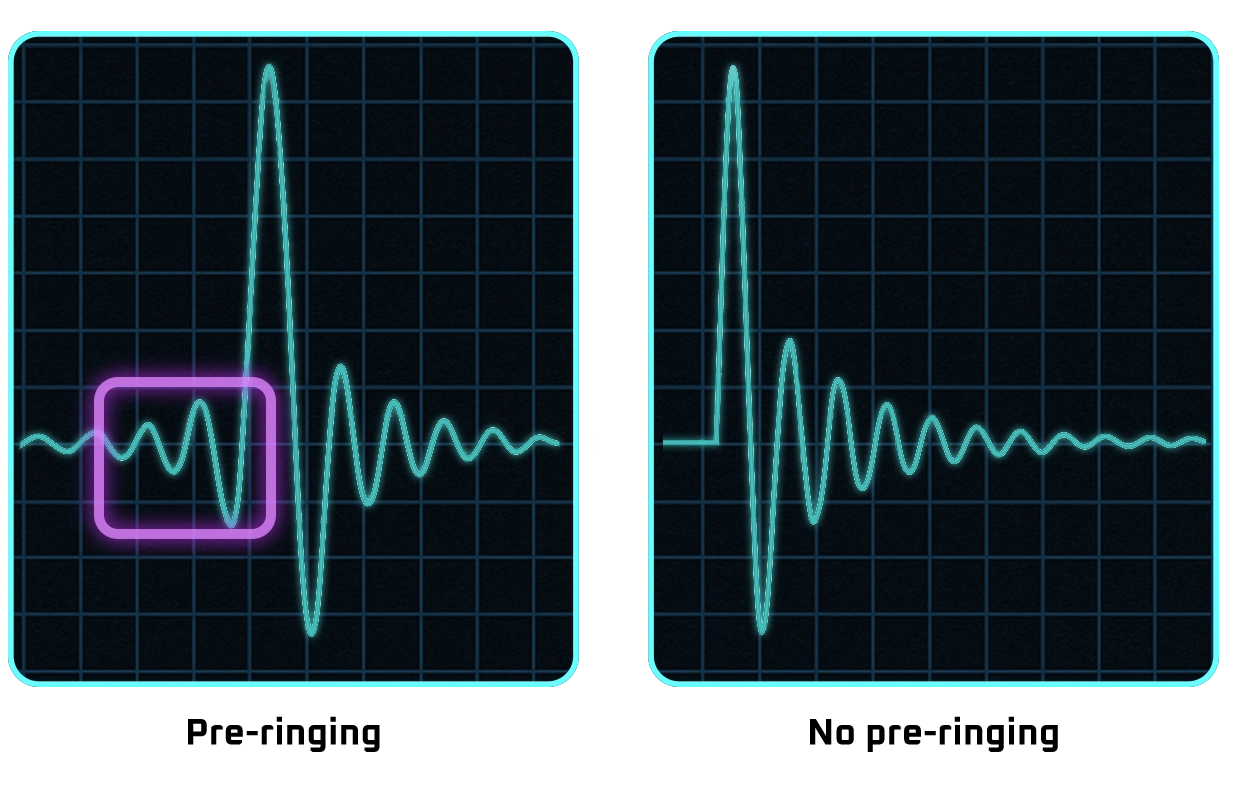
Linear Phase Resampling - Use this option for maximum transparency when resampling. It preserves phase relationships across frequencies — ideal for critical listening — but may introduce slight latency and pre-ringing artifacts. Disable for minimum-phase (faster) resampling with a more natural transient feel.
-
Allow Analytics - Allow us to measure and improve performance to understand which features are important and also if there are problems occurring. All data is anonymised. There is no personal identifiable information sent and we do not make available the data to third parties.
Resampler Overview
Hexcast includes a built-in high-performance resampler that ensures your audio is accurately streamed to any connected device, even when sample rates differ between your DAW and the playback target.
When a device connects via the browser interface, Hexcast automatically negotiates the optimal streaming configuration by detecting the device’s current sample rate. Based on this negotiation:
-
Upsampling occurs when the client device expects a higher sample rate than your DAW session (e.g. 48 kHz → 96 kHz).
-
Downsampling takes place when the client operates at a lower rate than your DAW (e.g. 192 kHz → 44.1 kHz).
This negotiation is handled independently for each connected client, allowing playback across devices at different sample rates in real-time.
|
If your DAW and the connected device operate at the same sample rate, Hexcast intelligently bypasses resampling altogether. In this passthrough mode, audio is streamed as-is for maximum fidelity and efficiency. |
Hexcast supports a wide range of common and high-end sample rates. Testing has confirmed successful playback up to 384 kHz in Windows and macOS systems, depending on browser and OS capabilities. Keep in mind that browser-based streaming relies on the system’s shared audio environment (WASAPI/Core Audio), which may limit playback rates compared to native ASIO performance.
Linear Phase Resampling
Hexcast includes an optional Linear Phase Resampling mode to give users greater control over audio fidelity when resampling between different sample rates (e.g., from 96kHz to 48kHz during streaming).
What It Does
When enabled, this setting uses linear-phase filters to preserve phase relationships across the entire frequency spectrum during the resampling process. This ensures maximum transparency, particularly useful during critical listening, mastering, and A/B comparison workflows.
Why Enable It?
-
Accurate phase response - no phase distortion introduced.
-
Greater spectral transparency - ideal for mastering or reference-critical listening.
-
Preserves stereo image integrity - useful for spatial mixes.
When to Disable It
-
For real-time responsiveness or low-latency situations.
-
When working with transient-heavy material (e.g., drums), where minimum-phase resampling may feel more “punchy” and immediate.
-
To reduce resampling latency - although small.
Technical Note
Linear-phase filters introduce pre-ringing artifacts and increase latency, which may be perceptible in some listening environments. Disabling this setting switches to minimum-phase resampling, which is faster and produces more natural-sounding transients at the cost of minor phase distortion.
Default Behavior
-
Enabled by default in Hexcast versions earlier than 1.1.0.
-
User-selectable from version 1.1.0 onward via the settings panel.
Port Hunter
In the event that you decide to assign new port numbers for Hexcast’s web server you may encounter a port clash with another service. Hexcast will check that the port is available on your system upon save. In the event that a conflict is detected, Hexcast will offer to find a suitable alternative for you. The following modal window is presented when a conflict arises. Answering ‘Yes’ will engage the port hunter and resolve your conflict. Answering ‘No’ will rollback your port changes to their original value.

Advanced Certificate Installation (Optional)
As mentioned prior, Hexcast allows the export of the self-signed certificate to be imported into the client certificate store to suppress the certificate errors raised by browsers on that machine.
Below describes how you would achieve that using the supported platforms.
MacOs
To install a self-signed certificate on macOS, you can follow these steps:
-
Export the certificate, using the Export Certificate button and save the crt file to a suitable location where you can locate it.
-
Launch the Keychain Access app on your Mac. You can find it in the Applications > Utilities folder, or you can use Spotlight search to locate it.
-
To import the Certificate, Go to File > Import Items and select the certificate file you exported earlier.
-
Select the appropriate keychain location (usually "login" or "System") and click "Add".
-
You may need to enter your administrator password to complete the import process.
-
After importing, double-click on the certificate in Keychain Access to open its details. Expand the "Trust" section and adjust the settings to "Always Trust" for SSL.
-
Close the certificate details window, and you may be prompted to authenticate again to save changes.
-
Restart any browsers that will be using the certificate to ensure they recognize the changes.
After following these steps, your self-signed certificate should be installed and trusted on macOS.
Windows
To install a self-signed certificate on Windows, you can use the following steps:
-
Export the certificate, using the Export Certificate button and save the crt file to a suitable location where you can locate it.
-
Open MMC (Microsoft Management Console):
-
Press Win + R to open the Run dialog, then type mmc and press Enter.
-
Add Certificates Snap-in: In the MMC window, go to File > Add/Remove Snap-in.
-
Select "Certificates" and click Add.
-
Choose "Computer Account" and click Next.
-
Select "Local Computer" and click Finish.
-
Click OK to close the Add or Remove Snap-ins window.
-
Import the Certificate, by expanding Certificates (Local Computer) > Personal.
-
Right-click on "Certificates" and choose All Tasks > Import.
-
Follow the Certificate Import Wizard to import the certificate file.
-
After importing, you may need to trust the certificate.
-
Navigate to Certificates (Local Computer) > Trusted Root Certification Authorities > Certificates.
-
Right-click in the right pane and choose All Tasks > Import.
-
Follow the wizard to import the certificate again, this time into the Trusted Root Certification Authorities store.
-
Restart any browsers that will be using the certificate to ensure they recognize the changes.
By following these steps, your self-signed certificate should be installed and trusted on Windows.
Troubleshooting
We hope when using Hexcast you have a trouble-free user experience. However, in the event that you experience problems this section aims to help you both diagnose and resolve problems during usage.
The Web Client Device Buffering
This typically occurs under the following conditions:
| Symptom | Possible Solutions |
|---|---|
|
Network bandwidth is exhausted. |
|
|
Low proximity to the network router. |
|
|
Network connection is too slow. |
|
Large Increase in Audio Latency has been introduced
There will always be some latency due to the nature of network technology/broadcasting. However, it is possible that the web client falls out of sync so much it diminishes the usefulness of Hexcast. By clicking the SYNC button on the Hexcast web client button bar will cause the web application to clear its internal buffer and resync with the DAW.
Device Limit Reached
Hexcast can support up to six devices connected simultaneously. The system will prevent the 7th web client device from joining the session to prevent Hexcast’s internal server from being overwhelmed.
Version Not Accepted
This occurs when you update the Hexcast plugin to a new version but you have not refreshed the page on your client device creating a version mismatch between the plugin and Hexcast client. To remedy this, simply refresh the browser on the client device and the web application should update to the latest version that the plugin serves.
No Connection
This typically occurs under the following conditions:
| Symptom | Possible Solutions |
|---|---|
|
Hexcast is not loaded into the current DAW session. |
|
|
Local Area Network is down. |
|
|
Stale web application session on the client device. |
|
No Audio on iPhone (Silent Switch)
This issue is commonly encountered on iOS devices when the physical mute switch is enabled, even though the web client shows a healthy signal and connection.
| Symptom | Possible Solutions |
|---|---|
|
The Hexcast web client shows signal activity, but no audio is heard on the iPhone. |
|

Tested on iPhone 6, iPhone 14 Plus, and iPhone 16 Pro Max (physical devices and simulators).
Plugin Fails to Load in Cubase 11 or Older DAWs
This issue can occur if the installed plugin format is incompatible with the capabilities of older DAWs such as Cubase 11.
| Symptom | Possible Solutions |
|---|---|
|
Plugin does not appear in Cubase 11’s plugins list or fails to load properly after installation. |
|
Load of Dependencies failed
This typically occurs under the following conditions:
| Symptom | Possible Solutions |
|---|---|
|
Similar to No Connection. It is possible to lose connection at the point to which the web client is downloading the artefacts from the internal web server to render the page. |
|
Flac Decode Error
This typically occurs under the following conditions:
| Symptom | Possible Solutions |
|---|---|
|
A chunk of audio became corrupted. |
|
No Main Window GUI Content
This plugin requires graphics hardware and compatible drivers supporting OpenGL 3.3 or later. Integrated graphics are supported; a dedicated graphics card is not required. Please ensure that your system meets these requirements and that compatible graphics drivers are installed.
Activation Failure After Reinstall
Hexcast uses information collected from your hardware to generate Licence Key Activation, so any substantial changes to the system will require a new activation code to be issued.
If you sign in to hexmarkrecords.com using your account credentials, navigate to the My Account section and under Licences you will see your licence information.
There should be an information box allowing you to regenerate an activation code. Click that button and begin the authorisation process again from the plugin window.
Hexcast Already Running

If you see the modal above you have multiple copies of Hexcast running on the system. Only one instance of Hexcast can run on a single system at any one time, independent of which host is running. Close any other instances of Hexcast down on your system, whether it be on a different channel or a different DAW. Hexcast exclusively uses the selected ports on a system thus cannot support multiple instances.
Appendix
Restricted Ports
The HTTP and HTTPS port numbers should fall within the range of 1024 - 65536 and not be considered a restricted port.
| Port | Description |
|---|---|
|
1719 |
H.323 Gatekeeper (h323gatestat): Used for video conferencing; often blocked for security. |
|
1720 |
H.323 Call Signalling (h323hostcall): Used for video conferencing; reserved. |
|
1723 |
Point-to-Point Tunneling Protocol (pptp): VPN protocol, deprecated and insecure. |
|
2049 |
Network File System (nfs): File sharing, privileged and often blocked. |
|
3659 |
Apple PasswordServer (apple-sasl / PasswordServer): Used for macOS directory services. |
|
4045 |
NFS lock manager (lockd): File locking, privileged. |
|
5060 |
Session Initiation Protocol (sip): VoIP, often targeted by attacks. |
|
5061 |
Secure SIP (sips): VoIP, reserved for encrypted SIP. |
|
6000 |
X Window System (X11): Remote desktop, security risk. |
|
6566 |
SANE (sane-port): Scanner Access Now Easy, rarely used, sometimes blocked. |
|
6665 |
Alternate IRC [Apple addition]: Internet Relay Chat, often blocked by firewalls. |
|
6666 |
Alternate IRC [Apple addition]: IRC (alternate), often blocked. |
|
6667 |
Standard IRC [Apple addition]: IRC (standard), often blocked. |
|
6668 |
Alternate IRC [Apple addition]: IRC (alternate), often blocked. |
|
6669 |
Alternate IRC [Apple addition]: IRC (alternate), often blocked. |
|
6697 |
IRC + TLS: IRC over TLS/SSL (secure IRC), often blocked. |
|
10080 |
Amanda: Amanda backup software, privileged. |
|
55555 |
Apple Reserved port: Reserved by Apple, not for general use. |
Glossary
Below is a list of terms used throughout the manual.
- Client Web Application
-
The browser-based interface delivered by the plugin that runs on the listener’s device.
- DAW
-
Digital Audio Workstation.
- HTTP
-
Hypertext Transfer Protocol - Web protocol for the transfer of web assets and data from the server to the client.
- HTTPS
-
Secure web protocol for the transfer of web assets and data from the server to the client.
- LAN
-
Local Area Network.
- Linear Phase Re-sampler
-
A resampler that preserves phase alignment across all frequencies but may introduce pre-ringing artifacts.
- Lossless Compression
-
Audio compression that exploits mathematical approximation of the signal where a human would not be able differentiate the difference between the compressed signal and that of the original.
- Minimum Phase Re-sampler
-
A resampler that avoids pre-ringing by allowing phase shifts, often sounding more natural around transients.
- PCM
-
Pulse Code Modulation - Digital representation of an analog signal using numerical values to represent the amplitude of a signal.
- PEM File
-
Privacy Enhanced Mail - A format to hold the self-signed TLS certificate used to establish trust between the client and web server.
- Port Hunter
-
An automatic tool in Hexcast that detects and resolves port conflicts on the system to ensure seamless device connectivity.
- QR Code
-
Quick Response Code. A pictorial representation of data that can be conveniently scanned by barcode reader software to avoid the user needing to enter the URL into the browser to launch the Hexcast web client.
- Sample Rate
-
The number of times per second that sample reading approximating an analog signal is taken, or the rate at which the samples are played back.
- Web Client Device
-
The device connected to Hexcast that receives the audio stream to play through its loudspeaker.
- Web Server
-
Internal program that offers to serve the micro website to run on the Web Client Device.
Credits
Programming and Design by Aaron Browne (aka Assonance).
Artwork by Stomping Creation Studio (https://stompingcreations.myportfolio.com)
User Manual Design by Aaron Browne
Copy Editing by J. A. Browne (https://jabrowne.com)
End User Licence Agreement (EULA) for Hexcast
Agreement version: 2026-10-12.
Please read this Agreement before installing or using Hexcast. Keep a copy for your records.
1. Parties, scope and acceptance
This Agreement is between you and Hexmark Records Ltd, registered company number 10933357, of Wisteria, The Grange Barn, Pikes End, Pinner, London HA5 2EX, United Kingdom ("Hexmark", "we", "us" or "our").
"You" means the individual or legal entity acquiring the licence. If you accept on behalf of an entity, you must have authority to bind that entity. Acceptance does not automatically bind its affiliates.
"Software" means the proprietary Hexcast software we supply, including native plug-ins, the browser application, JavaScript, workers, WebAssembly components, proprietary assets, documentation and updates supplied under this Agreement. Third-party components are addressed in section 11.
"Licence Details" means the licence duration, authorised users, installations and usage limits expressly agreed and made available when your licence is supplied. They do not include restrictions introduced later without agreement. Technical limits described in the documentation are not, by themselves, additional purchased-licence limits.
This Agreement covers paid licences and trials acquired from us or an authorised reseller. A reseller or merchant of record may separately govern the purchase, payment and refunds; this Agreement governs the Software licence and does not remove rights under that purchase contract.
By expressly accepting this Agreement, or installing or using the Software after this Agreement has been made available to you with a reasonable opportunity to read it, you agree to its terms. If you do not agree, do not install or use the Software and contact the seller about your applicable cancellation or refund rights.
An existing licence is not retrospectively replaced merely because we publish this version. Changes to an existing agreement require an effective agreement with you in accordance with applicable law. An update does not, by itself, reduce previously agreed licence rights.
2. Licence grant and permitted use
Subject to this Agreement and the Licence Details, we grant you a non-exclusive licence to install and run the Software on devices under your control and to use its intended functionality, including within compatible digital audio workstations (DAWs) and through connected web browsers.
The licence is personal to the licensed individual or entity. You may allow the authorised users identified in the Licence Details to operate the Software. If the Licence Details do not identify additional users, they do not create a separate licence for another person to install or operate the native plug-in independently. You may allow collaborators and clients to listen through the intended browser connections within your authorised Hexcast session. Take reasonable steps to ensure that users you permit to access your licensed session comply with the applicable restrictions in this Agreement.
You may use the Software for personal and professional audio work, including paid mixing, mastering and other work for clients. You may distribute your own audio and project content without licensing that content to us.
You may make the copies reasonably necessary for authorised installation, execution, browser loading, caching and backup. You may configure the Software, use documented customer integrations, manage documented network and certificate settings, and perform ordinary compatibility, playback, latency and performance checks for your permitted use. We may also authorise troubleshooting, support, integration or security-research activities in writing.
The licence continues for the duration agreed in the Licence Details, or until terminated under section 14 if no expiry was agreed. Trial use is subject to the trial period and limits disclosed when the trial is supplied. Updates and support are included only to the extent agreed when supplied; this Agreement does not promise an unspecified support period or future feature set.
You may not transfer or sublicense the Software licence without our written permission, except to the extent applicable law prevents that restriction. Supported reinstallation, licence recovery and hardware migration within your licence are permitted.
3. Mandatory rights and statutory exceptions
Every restriction in this Agreement, including restrictions on analysis, competition, automated extraction, AI use, confidentiality and technical controls, is subject to this section. Nothing in this Agreement prohibits or restricts an activity to the extent that applicable law prevents that prohibition or restriction.
In particular, this Agreement preserves a lawful user’s rights to make necessary backups under section 50A of the Copyright, Designs and Patents Act 1988; qualifying decompilation for interoperability under section 50B; and observation, study or testing of program functioning under section 50BA. Terms restricting those qualifying acts are void to the extent provided by section 296A.
Those rights remain subject to their statutory conditions. Interoperability decompilation must be necessary for the permitted objective, be limited to the necessary acts, and comply with the limits on availability, use and disclosure of the resulting information. It does not permit copying substantially similar program expression or other copyright infringement. Observation, study and testing rights apply while performing the acts the lawful user is entitled to perform.
Other applicable mandatory exceptions are also preserved, including qualifying copying for computational analysis for solely non-commercial research under section 29A. Necessary copying or adaptation, including error correction, must be assessed under section 50C and other applicable law; this Agreement does not remove any right that cannot lawfully be restricted.
No prior permission, notification, fee or additional confidentiality undertaking is required for a statutory activity where applicable law does not permit us to impose that condition. You may contact us for interoperability information or support, but doing so is not an additional condition of a mandatory right.
4. Licence restrictions
Except as permitted by sections 2 and 3, separately authorised by us in writing, or permitted by the applicable third-party licence, you must not:
-
Copy, extract, reproduce, publish or reuse the Software or its proprietary Implementation Material outside your licence.
-
Edit, alter, modify, adapt or translate the Software, or create works derived from its protected code, documentation or assets.
-
Distribute, sublicense, sell, resell, rent, lend or otherwise supply the Software to another person, or offer it as a separate hosted product or service.
-
Remove, obscure or alter copyright, trademark, licence, attribution or other proprietary notices supplied with the Software.
-
Knowingly procure or assist another person to perform an act prohibited by this Agreement.
The intended serving of the browser application to permitted connected devices, use within compatible DAWs, configuration, permitted customer integrations, and creation or distribution of your own audio and project content are not prohibited incorporation, modification, redistribution or hosting.
5. Reverse engineering and implementation protection
"Implementation Material" means proprietary material forming part of the Software, including source and object code, source maps, code representations of algorithms and data structures, internal implementation documentation, protocol implementation code, and proprietary user-interface assets. It does not include your content or third-party material licensed separately, and this definition does not assert ownership of unprotected ideas, functionality, standards or information.
Subject to section 3 and the permitted use and authorisations in section 2, you must not reverse engineer, decompile or disassemble the Software; decode, reconstruct or attempt to discover its source code; or inspect, analyse or extract Implementation Material to reproduce or reuse the proprietary implementation outside your licence.
Delivery of JavaScript, other source-like code or Implementation Material to a browser, client device or runtime does not transfer ownership or grant rights to modify, publish, redistribute or reuse it beyond this Agreement or applicable law. Readability, browser developer tools, minification, obfuscation, source maps and the absence of an access control do not enlarge the licence.
These restrictions do not prohibit the ordinary browser and diagnostic activities reasonably required for permitted use or authorised support, or any activity preserved by section 3.
6. Competing implementations, automated extraction and AI
Subject to section 3, you must not use Implementation Material copied or extracted outside your licence, our Confidential Information outside its permitted purpose, or material obtained through an act prohibited by this Agreement to develop, reproduce or assist a competing or substitute implementation of the Software.
You must not use automated tools to harvest or reconstruct Implementation Material outside your licence, or systematically capture internal program material for those prohibited purposes.
You must not supply the Software or proprietary Implementation Material as training data, a training corpus, embeddings or another development input for software or AI systems intended to reproduce its proprietary implementation or provide a competing or substitute implementation, except where we authorise that use or section 3 applies.
This section does not prohibit independent development that does not misuse protected material or Confidential Information; mandatory statutory activities; permitted customer integrations; ordinary compatibility or performance testing; truthful product reviews; or use of your own audio and project content with other software or AI tools. It does not claim exclusive rights over functionality, ideas or knowledge lawfully obtained through activities that applicable law protects.
7. Technical controls, activation and credentials
Subject to sections 2 and 3, you must not disable, evade, falsify or interfere with licensing, activation, authentication or security controls; falsify activation credentials or device information to obtain unauthorised access; or defeat agreed installation, authorised-user or trial limits.
You must not publish, sell or share licence keys, activation codes or account credentials to enable unauthorised use. Take reasonable care to protect them and notify us promptly when you become aware of their unauthorised use. Access by authorised users must remain within the Licence Details and any supported account-access arrangements.
Documented licence recovery, reinstallation, hardware migration, network configuration, browser permissions and certificate export or import are permitted. An activation failure does not, by itself, establish a licence breach; contact support to resolve it. We will not treat the exercise of a mandatory statutory right as a breach or a ground for suspension.
8. Intellectual property and customer content
The Software is licensed, not sold. Hexmark and its licensors retain their respective intellectual-property rights in the Software and in updates and modifications they supply. No ownership transfers through installation, download, access or browser delivery. Rights not expressly granted or preserved by law are reserved.
You retain your rights in your audio, recordings, project files, settings and independently created material. Use of the Software does not give us ownership of that content or make it a derivative of the Software merely because Hexcast processes, streams or stores it.
This Agreement does not automatically assign to us rights in separately authored customer contributions, independent integrations or modifications. Any authorised development arrangement requiring an assignment must address ownership expressly in an appropriate separate agreement. This does not authorise modifications prohibited elsewhere in this Agreement or affect our rights in the underlying Software.
9. Confidential information
"Confidential Information" means non-public technical or business information we disclose to you in confidence and identify as confidential, or that a reasonable recipient would understand to be confidential in the circumstances. This may include non-public source code, unreleased designs, internal technical documents or restricted support disclosures.
Use Confidential Information only for the authorised use, integration or support for which it is disclosed, and protect it with reasonable care. You may disclose it to authorised personnel and professional advisers who need it for that purpose and are subject to appropriate confidentiality duties.
Confidential Information excludes information that becomes public without a breach of duty, was already lawfully known without restriction, is independently developed without use of the disclosure, or is lawfully received from a third party without restriction.
Software or JavaScript is not Confidential Information solely because it is delivered with a proprietary notice. Copyright protection and applicable licence restrictions remain separate from confidentiality.
Disclosure required by law or a competent authority is permitted. Where lawful and practicable, give us advance notice and limit disclosure to what is required. This section does not restrict mandatory statutory rights, protected disclosures or reporting to a regulator or law-enforcement authority.
10. Privacy and support information
Activation and related services may require account information and device identifiers. Any collection and use of personal information must comply with applicable data-protection law and the privacy information made available for the relevant product or service. The published privacy policy is available at https://hexmarkrecords.com/policy/privacy.
This Agreement is not blanket consent to collect information in any manner, to use support material for unrelated purposes, or to send marketing. Optional analytics and marketing remain subject to the applicable choices and legal requirements. Before sending support logs or project material, remove information you do not wish to share where practicable; we will request only information reasonably needed for the support purpose.
11. Third-party components and other agreements
Third-party components remain subject to their applicable licences and notices supplied with the Software. If this Agreement conflicts with rights granted under a third-party licence, that licence governs the relevant component. It does not grant rights in Hexmark’s separate proprietary code. Nothing here claims ownership of a third party’s material or restricts rights that its applicable licence grants you.
This Agreement governs the Software licence alongside the Licence Details and any expressly agreed written variation. The Licence Details define the commercial scope described in section 1; they do not silently override the protections in section 3. A written variation expressly agreed by both parties may govern the matters it specifically addresses, subject to mandatory law and third-party rights.
The Hexcast Proprietary Licence (HPL) notice and source, browser and package notices summarise ownership and refer to this Agreement. They are not separate licence grants or additional warranty exclusions. A notice does not change the Agreement you accepted.
Website and purchase terms may govern their respective services and transactions, but do not by themselves enlarge the Software restrictions or retrospectively replace this Agreement. Any inconsistency affecting mandatory rights is resolved in favour of those rights.
12. Warranties, service obligations and consumer rights
If you are a consumer, nothing in this Agreement excludes statutory rights concerning digital content or services. These may include rights that content be of satisfactory quality, fit for an agreed purpose and as described, and applicable rights to repair, replacement, price reduction or refund. Cancellation and refund rights are governed by applicable law and your purchase contract; this Agreement does not make them conditional on returning materials where the law does not permit that condition.
For business customers, we will exercise reasonable care and skill in services we agree to provide and will comply with any express written product warranties. Subject to those obligations and section 13, other warranties or terms implied by law are excluded only to the extent their exclusion is lawful and reasonable.
We do not promise that the Software will be free of every error, operate with every device, DAW or network, or meet requirements beyond its agreed description and specifications. This does not override express commitments or statutory obligations. You should keep appropriate backups of your audio and project content.
13. Liability
Nothing in this Agreement excludes or restricts liability for death or personal injury caused by negligence, fraud or fraudulent misrepresentation, or any liability, obligation, right or remedy that cannot lawfully be excluded or restricted.
If you are a consumer, we are responsible for loss or damage that is a foreseeable result of our breach of this Agreement or failure to use reasonable care and skill. We do not exclude remedies that the Consumer Rights Act 2015 or other applicable law makes available to you. The business limitations below do not apply to consumers.
For business customers only, subject to the first paragraph of this section and to the extent lawful and reasonable, we are not liable for indirect or consequential loss, or loss of profits, revenue, anticipated savings, business opportunity or goodwill. Our total liability arising out of or in connection with the affected Software licence is limited to the amount you actually paid for that licence. This limitation remains subject to applicable reasonableness requirements and does not limit a remedy that cannot lawfully be limited.
You are not required to indemnify us merely because you legitimately use the Software. Each party remains responsible for its own breaches and liabilities under applicable law; this Agreement does not impose a general indemnity for all claims connected with your use.
14. Termination, suspension and continued use
You may terminate your licence at any time by notifying us and stopping use. Voluntary termination does not itself create a refund entitlement, but does not remove any refund or cancellation right you otherwise have.
We may terminate for a material breach by written notice. If the breach can be remedied, we will identify it and give you at least 14 days to remedy it before termination. We may terminate immediately by written notice for deliberate unauthorised distribution, deliberate circumvention, or a material misuse of intellectual property or Confidential Information that cannot be remedied.
Where reasonably necessary to prevent an ongoing material breach or security threat, we may temporarily suspend affected activation or service access. Suspension must be proportionate and limited to what is reasonably necessary. We will explain the grounds as soon as reasonably practicable, review them promptly, and restore access when they are resolved. You may contact us to challenge or resolve a suspension. Exercise of a right preserved by section 3 is not a ground for suspension or termination.
On expiry or lawful termination, stop using and uninstall the Software, cease making it available to others, and delete copies and proprietary extracts you are no longer entitled to retain. Retention required by law is permitted if the retained material is protected and not used to continue operating the Software. Independent rights under applicable law or third-party licences remain unaffected.
Termination does not transfer your content to us or require deletion of your audio or project files. Accrued claims and mandatory consumer remedies remain unaffected.
We will not use withdrawal of a related service alone to revoke an otherwise continuing paid Software licence. If we discontinue an activation service required for its continued use, we will make reasonable arrangements to support continued lawful operation or provide remedies required by the applicable contract and law. This does not authorise bypassing controls without permission or a legal entitlement.
15. Remedies and survival
Unauthorised copying, distribution, circumvention or misuse of Confidential Information may cause harm that damages alone cannot adequately remedy. We may seek an injunction or other relief available under applicable law; the court determines whether relief is appropriate. Contract breach is not, by itself, a criminal offence.
Either party may pursue remedies available for a breach in the circumstances, without double recovery for the same loss. This Agreement does not guarantee an injunction, a particular damages award or recovery of legal costs.
Intellectual-property ownership, restrictions on retained material, confidentiality for information that remains confidential, termination consequences, accrued rights, applicable liability provisions, remedies and dispute resolution survive expiry or termination to the extent relevant. Survival does not authorise continued use of the Software or prohibit acts that applicable law protects.
16. Governing law, disputes and general terms
This Agreement and related non-contractual disputes are governed by the laws of England and Wales. If you are a consumer, this choice does not deprive you of mandatory protections applicable under the law of your habitual residence.
For business customers, the courts of England and Wales have exclusive jurisdiction. Consumers may bring proceedings in any court available to them under applicable mandatory law; nothing here removes that right.
If a provision is invalid or unenforceable, it does not affect the remaining provisions to the extent they can lawfully operate. This does not make an otherwise prohibited restriction enforceable. A delay in exercising a right is not, by itself, a waiver. Statutory rules on interpretation and consumer fairness remain applicable.
This Agreement, the Licence Details and expressly agreed variations set out the Software licence. They do not exclude liability for fraud, override mandatory pre-contract information or remove rights under an applicable purchase contract.
Contact us about this Agreement, support, interoperability or a suspension through https://hexmarkrecords.com/contact or at the registered address in section 1.
Legal Information
Hexcast ® is a registered trademark of Hexmark Records Ltd. (2022).
Hexmark Records ® is a registered trademark of Hexmark Records Ltd. (2017).
AAX and Pro Tools are trademarks or registered trademarks of Avid Technology, Inc. or its subsidiaries in the United States and/or other countries.
VST ® is a registered trademark of Steinberg Media Technologies GmbH.
Cubase ® is a registered trademark of Steinberg Media Technologies GmbH.
macOS, iPhone, Safari and the Mac logo are trademarks of Apple Inc., registered in the U.S. and other countries and regions.
Microsoft, Microsoft Edge, Windows and the Windows logo are trademarks of the Microsoft group of companies.
Intel is a trademark of Intel Corporation or its subsidiaries.
Chrome™ and Chromium™ are trademarks of Google LLC.
Firefox is a trademark of the Mozilla Foundation in the U.S. and other countries.
Brave is a trademark or registered trademark of Brave Software, Inc.
Opera is a trademark of Opera Norway AS or its affiliates.
All trademarks are the property of their respective owners. Use of these names does not imply endorsement or affiliation.
© Copyright 2026 Hexmark Records Ltd. All rights reserved. Hexcast, Hexmark Records and other marks which may from time to time appear are the trademarks or UK registered trademarks of Hexmark Records Ltd in the United Kingdom.